
From women’s divorce rights history to filing North Carolina divorce papers for free, this plain-language guide covers every right you have, every step of the way.
Table of Contents
- A Look Back at Women’s Divorce Rights: The Long Road to Legal Equality
- The Changing Landscape of Divorce Today
- No-Fault Divorce in NC: What It Means for Women
- Divorce from Bed and Board: A Lesser-Known NC Option
- Ending a Marriage in NC: Can You Skip the One-Year Separation Rule?
- Your Rights to Property Division
- Your Rights to Alimony and Spousal Support
- Divorce in NC with a Child: Custody and Support Rights
- North Carolina Divorce Papers: What You Need and Where to Get Them
- How to File for Divorce in NC for Free
- Uncontested Divorce in NC Online: Is It Right for You?
- Special Situations: When Your Spouse Was Abusive
- Step-by-Step: How to File for Divorce
- What If You Disagree with the Judge’s Decision?
- Why the Right Attorney Changes Everything
Imagine this: Maria, a 38-year-old mother of two from Raleigh, North Carolina, had spent 12 years as the primary caregiver for her children while her husband built his career.
When she finally decided to file for divorce, her biggest fear wasn’t the paperwork it was the quiet, gnawing question: Do I even have any rights here?
The answer is a resounding yes. Understanding your divorce rights for women is the first and most powerful step you can take toward a fair outcome.
Furthermore, if you live in North Carolina, there are specific state laws and procedures you need to know that can significantly affect your case. This guide covers both in plain, everyday language.
Women’s Divorce Rights History: How Far We’ve Come womens-divorce-rights-history

To fully appreciate your divorce rights for women today, it helps to understand the remarkable distance we’ve travelled. For much of American history, women had almost no legal standing in a divorce.
Under the doctrine of coverture, a married woman’s legal identity was absorbed entirely into her husband’s she could not own property, sign contracts, or initiate legal proceedings independently.
The landscape began to shift through the 19th and 20th centuries. The Married Women’s Property Acts, passed in many states beginning in the 1840s, gave women the right to own property in their own name. Meaningful access to divorce, however, remained severely limited requiring proof of fault such as adultery or cruelty, which placed enormous legal and social burdens on women seeking to leave harmful marriages.
The watershed moment came in 1969, when California became the first state to enact no-fault divorce legislation.
By 2010, all 50 states including North Carolina had adopted some form of no-fault divorce. This single legal change transformed millions of women’s ability to exit unhappy or dangerous marriages without having to prove wrongdoing in open court.
“Knowing the origins of these rights is what gives us the strength to protect and advocate for them.”
Today, modern family law across the United States is gender-neutral by design. Yet equal on paper does not always mean equal in practice, which is precisely why knowing the law and enforcing it still matters enormously for women in divorce.
| Milestone | Year |
|---|---|
| First Married Women’s Property Act passed | 1839 |
| First no-fault divorce law enacted (California) | 1969 |
| All 50 states adopt no-fault divorce | 2010 |
| Women initiate ~70% of U.S. divorces | Today |
The Changing Landscape of Divorce Today changing-landscape

Studies conducted over time reveal that roughly 7 in 10 divorces across the United States are filed by women rather than their male partners.
This shift reflects three converging forces: greater financial independence, broader awareness of mental health and personal wellbeing, and the steady dismantling of the social stigma that once kept women silent in unhappy marriages.
Moreover, changing gender roles have played a defining role. Traditional expectations that women should be the primary caregivers and homemakers have evolved significantly.
Modern marriages increasingly feature more equal dynamics and as those dynamics shift, women feel less bound by the expectation of staying in a marriage that no longer serves them or their children.
Consequently, the practical question for most women today is not whether they have the right to divorce they do — but how to exercise that right effectively to protect their financial security, their children, and their future.
No-Fault Divorce in NC: What It Means for Women no-fault-divorce-nc
No-fault divorce in NC is the most straightforward path to ending a marriage in North Carolina. Under NC law, the only ground required for an absolute divorce is that you and your spouse have lived separately and apart for at least one full year, with the intention that the separation be permanent.
Under this process, neither spouse is required to demonstrate fault or wrongdoing on the part of the other party.
You simply need to demonstrate that you have lived in separate residences for 12 continuous months and that at least one of you intended the separation to be permanent from the outset.
No-fault divorce in NC is particularly protective for women because it removes the burden of proving misconduct in open court.
Even if your husband committed adultery, you are not required to go through a public, potentially re-traumatising fault proceeding simply to obtain your divorce.
However, fault can still be raised as a separate matter particularly when it affects alimony determinations, as discussed below.
Editorial note: In North Carolina, sexual relations during the separation period may restart the one-year clock entirely.
Maintain a clear, documented separation separate addresses, separate finances, and a written record of your separation date to protect your eligibility.
Divorce from Bed and Board: A Lesser-Known NC Option {#divorce-from-bed-and-board}

Many women are surprised to learn that North Carolina recognises a unique legal remedy called divorce from bed and board known in legal shorthand as a DBB.
Despite what the terminology suggests, this legal classification does not constitute a complete or final dissolution of marriage.
The marriage remains legally intact under this arrangement, meaning neither individual is permitted to enter into a new marriage.
Instead, it is a court-ordered legal separation that carries significant practical consequences.
A bed and board divorce is only available when one spouse can establish fault, which may include the following grounds:
- Abandonment by the spouse
- Malicious turning out of doors (forcing a spouse to leave the home)
- Treatment so harsh or violent that it places the other spouse’s physical safety or life in genuine danger.
- Indignities that render the condition of the other spouse intolerable
- Excessive use of alcohol or drugs
- Adultery
Why does this matter for women’s divorce rights? A divorce from bed and board can be a powerful strategic tool, particularly in situations involving domestic abuse, financial control, or a spouse who refuses to vacate the marital home.
It can establish the legal separation date which is critical for starting North Carolina’s one-year separation clock and it can help secure the marital home and financial support while the full divorce process unfolds.
Story: Lisa, a mother of three in Charlotte, NC, was afraid to leave the marital home because she feared losing access to it during the divorce.
Her attorney filed for a divorce from bed and board based on her husband’s documented cruelty, which allowed the court to order him to vacate the home establishing her legal separation date and protecting her residence while the one-year period ran.
Dissolving Your NC Marriage Before the One-Year Mark: Is It Possible?
One of the most frequently asked questions about divorce rights for women in North Carolina is this: is there any way to get a divorce without waiting the full 12-month separation period?
North Carolina’s absolute divorce law requires the one-year separation in virtually all cases. However, there are legitimate legal strategies that can make the most of that period or address urgent needs before it ends.
What you can do during the separation year
The separation period does not have to be a period of legal inaction. In fact, it is often the most strategically important time in the entire divorce process.
Throughout this twelve-month period, there are several constructive steps you can and should take:
- File for post-separation support temporary financial support to meet your needs while the divorce is pending. Unlike final alimony, this can be awarded quickly without waiting for the full trial.
- Pursue a child custody order courts can issue temporary custody and parenting time arrangements immediately, before the divorce is final.
- If you or your children face immediate danger, pursue an emergency domestic violence protective order without delay courts can issue these on the very day of your application.
- File for equitable distribution you can initiate the property division claim during the separation period, ensuring it is preserved before the divorce is finalised.
- Negotiate a separation agreement a legally binding contract signed by both spouses that resolves property, support, and custody issues, potentially making the final divorce swift and straightforward.
Critical timing warning: In North Carolina, claims for equitable distribution and alimony must be filed before the divorce is made absolute.
If you wait until after the divorce decree is entered, you permanently lose the right to pursue those claims. Do not delay consult an attorney as soon as possible after separation begins.
Your Rights to Property Division {#property-division}

Property division is often the most contested element of a divorce. The reassuring truth is that the law recognises your contributions to the marriage even if you never earned a paycheck during it.
Most U.S. states including North Carolina, Colorado, Tennessee, and New Jersey follow the principle of equitable distribution. This means marital property is divided fairly, though not automatically 50/50. A judge weighs several factors, including:
- The duration of the marriage
- Each spouse’s financial and non-financial contributions including caregiving and homemaking
- Each spouse’s economic circumstances following the divorce
- The value of each spouse’s separate property
- Marital misconduct, in states where this is legally relevant
A small number of states use community property rules instead, where most assets and debts acquired during the marriage are divided exactly 50/50 regardless of who earned or purchased them. North Carolina is not one of them.
Crucially, separate property assets owned before the marriage, or received as a gift or inheritance is generally not subject to division.
However, the line between marital and separate property can blur over time, which is one of many reasons professional legal guidance matters enormously.
Watch out for this: If your spouse argues that assets belong solely to them because they were the one who “paid for everything” that argument does not hold up under equitable distribution law.
Courts are required to recognise both financial and non-financial contributions, including years spent raising children or supporting a spouse’s career advancement.
Story: Sarah, a stay-at-home mother from Colorado Springs, had no idea what accounts existed solely in her husband’s name.
Before filing, she photographed every financial document in their home tax returns, brokerage statements, old loan paperwork. That evidence later helped her attorney secure a far more equitable property settlement than she had initially thought possible.
Financial Support After Separation: Understanding Your Alimony Entitlements
Alimony also called spousal maintenance or spousal support is financial assistance paid from one spouse to the other following a divorce. It is not automatic, and it is not gender-based.
A judge determines whether it is appropriate based on the specific facts of your case.
Common factors courts consider include:
- Each party’s gross income and earning capacity
- The lifestyle and financial comfort both spouses maintained throughout the duration of the marriage.
- The length of the marriage
- Whether either spouse sacrificed professional growth or career opportunities to manage the home and support the family.
- Each spouse’s age, health, and financial resources
- Tax implications of any award
Fault matters for alimony in North Carolina in a way it does not for the divorce itself. Under NC General Statutes § 50-16.3A:
- If the supporting spouse (higher earner) committed adultery, the dependent spouse is entitled to alimony as a matter of law.
- If the dependent spouse committed adultery, they are barred from receiving alimony unless the supporting spouse also committed adultery, in which case the judge has discretion.
North Carolina also allows post-separation support temporary alimony that can be awarded during the separation year before the final divorce is granted.
This is particularly valuable for women who were not employed outside the home or who earn significantly less than their spouse.
In Tennessee, four distinct types of alimony are available:
- Rehabilitative alimony Temporary support designed to help you achieve financial self-sufficiency, often while completing education or job retraining. This arrangement concludes automatically upon the passing of either individual involved.
- Periodic alimony Long-term support awarded when the income gap is too significant to close through rehabilitation alone. Ends on a court-set date, or upon remarriage or death.
- Transitional alimony A short-term award to help you adjust to independent life post-divorce. Can be modified if you begin cohabiting with another person.
- Lump sum alimony (alimony in solido) A fixed total amount paid all at once or in installments. Uniquely, it does not terminate upon remarriage or death.
Story: Jennifer had been married for 18 years and hadn’t worked outside the home in over a decade. When she filed for divorce in Colorado, she feared she had no financial footing.
Her attorney successfully argued for rehabilitative alimony while she completed a nursing certification program, alongside transitional support to cover her living costs. Two years later, she was fully financially independent.
Important nuance: Even in cases involving adultery, spousal support may still be awarded if denying it would be unjust — particularly when a wife has been out of the workforce for years and has no independent income.
Divorce in NC with a Child: Custody and Support Rights {#divorce-nc-with-child}
For women navigating divorce in NC with a child, custody arrangements are among the most emotionally charged and legally consequential matters to resolve.
The governing standard in North Carolina, as in all U.S.The guiding legal principle applied across states is centered on whatever outcome best serves the child’s overall wellbeing.
. Gender plays no role in this determination. Mothers are not automatically favoured nor are fathers.
North Carolina recognises two dimensions of custody:
- Legal custody The right to make significant decisions about your child’s education, healthcare, and religious upbringing. NC courts generally prefer that parents share legal custody jointly.
- Physical custody determines the primary residence of the child and establishes how time spent with each parent is structured and divided.. The arrangement that best serves the child’s stability and wellbeing governs not a presumption of equal time.
Child support in North Carolina is calculated using the NC Child Support Guidelines a formula based on both parents’ gross incomes, the number of overnights each parent has, and The child’s individual requirements, covering medical care expenses and the cost of childcare arrangements, are taken into full consideration.
Child support is the child’s legal right and cannot be waived by either parent.
Editorial note: In North Carolina, custody orders can be sought immediately upon separation you do not need to wait for the one-year separation period to expire. If your situation involves domestic violence or safety concerns for your children, an emergency custody order can be obtained the same day.
Story: Jennifer had been a stay-at-home mother in Durham, NC for eight years. When she filed for divorce, she was worried that her lack of income would weaken her custody case. In fact, the court recognised her role as the children’s primary caregiver as a significant factor in determining their best interests and awarded her primary physical custody, with child support calculated based on her husband’s income and the custody split.
Watch out for this: Some spouses or aggressive “father’s rights” attorneys may argue that custody should automatically default to 50/50 as a matter of fairness.
Under Colorado and NC law, courts are explicitly required to consider the best interests of the child as the only governing standard. Your attorney should be prepared to assert this clearly.
North Carolina Divorce Papers: What You Need and Where to Get Them {#nc-divorce-papers}
Filing for divorce in North Carolina requires a specific set of North Carolina divorce papers. Knowing exactly what is required and where to find it saves time, prevents procedural errors, and keeps your case on track.
Required documents for an absolute divorce in NC:
- Complaint for Absolute Divorce (Form AOC-CV-401) The primary filing document that initiates your divorce. It states the grounds (separation for one year) and identifies both parties.
- Civil Summons (Form AOC-CV-100) The formal notice that must be served on your spouse to inform them of the proceedings.
- Domestic Civil Action Cover Sheet (Form AOC-CV-750) A required administrative form identifying the nature of the case.
- Proof of service Documentation confirming your spouse was properly served with the divorce papers, as required by NC Rules of Civil Procedure.
- Financial affidavits Required if you are also filing claims for alimony, post-separation support, equitable distribution, or child support.
All formally required North Carolina divorce documentation is accessible to the public at no cost through the appropriate official channels.
NC Courts official forms portal. You can also obtain them in person at the clerk’s office of your county’s District Court.
Editorial note: Incorrect or incomplete North Carolina divorce papers are one of the most common reasons for case delays and dismissals.Any mistakes made during the service of process stage may force you to abandon all progress and begin the entire procedure from the beginning.
If any issue in your divorce is contested property, support, or custody working with an attorney to prepare your documents is strongly advisable.
How to File for Divorce in NC for Free {#file-divorce-nc-free}
Cost is one of the most significant barriers women face when considering divorce. The good news is that it is genuinely possible to file for divorce in NC for free or at very low cost if you know where to look.
Fee waiver (In Forma Pauperis)
If you cannot afford the standard court filing fee (typically $225 in NC), you may apply for a fee waiver using Form AOC-G-106 a Petition to Proceed as an Indigent. If the court approves your application, the filing fee is waived entirely.
Free legal aid organisations in NC
Several organisations provide free or low-cost legal assistance specifically for women navigating divorce in North Carolina:
- Legal Aid of North Carolina Free civil legal services for low-income individuals, including divorce, custody, and domestic violence cases.
- NC State Bar Lawyer Referral Service Connects you with an attorney for a reduced-fee initial consultation.
- NC Justice Center Resources and referrals for low-income residents facing family law issues.
- LawHelp NC Free online guides and referrals specific to North Carolina family law.
Self-representation (Pro Se)
For straightforward, uncontested divorces with no contested property, support, or custody issues, self-representation filing pro se is a legitimate option. The NC Courts system provides step-by-step self-help guidance at nccourts.gov/court-assistance.
However, if your case involves children, significant assets, or any dispute, professional legal guidance is strongly recommended.
Uncontested Divorce in NC Online: Is It Right for You? {#uncontested-divorce-nc-online}
An uncontested divorce in NC online is possible when both spouses fully agree on all issues and increasingly, women are using online platforms to complete the process efficiently and affordably.
An uncontested divorce in NC is appropriate when:
- You and your spouse must have been living separately and apart for a minimum period of twelve consecutive months.
- You both agree there are no contested property, debt, or asset division issues
- There are no outstanding alimony claims (or you have settled them in a separation agreement)
- Any child custody and support arrangements have already been fully resolved
Reputable online legal services including Nolo and LegalZoom offer guided document preparation tools that generate correctly formatted North Carolina divorce papers for an uncontested filing, typically for $100–$300.
Proceed with caution: Online divorce tools are only appropriate for truly simple, fully agreed-upon cases.
If there is any ambiguity about property division, if children are involved in an unresolved custody dispute, or if you suspect your spouse may not honour agreements, an online service is not sufficient and using one without legal advice could permanently affect your rights to property, support, and custody.
Special Situations: When Your Spouse Was Abusive {#abusive-spouse}
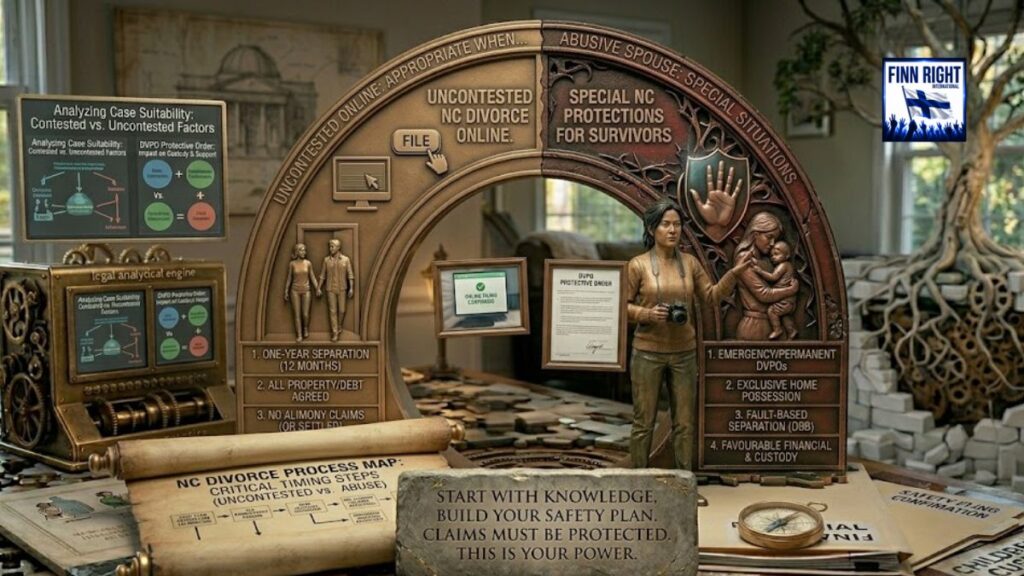
If you are a survivor of domestic violence or abuse, the legal system includes specific protections designed for you including in North Carolina:
- Domestic Violence Protective Orders (DVPOs) NC courts can issue emergency and permanent protective orders keeping an abusive spouse away from you and your children, often the same day you apply.
- Exclusive possession of the marital home A court can order your abusive spouse to vacate the family home, providing immediate safety and stability.
- Divorce from bed and board As detailed above, fault-based separation orders are available for abuse victims and can establish legal separation without requiring you to find alternative housing first.
- Favourable financial and custody outcomes Documented domestic violence significantly influences equitable distribution, alimony, and custody determinations in North Carolina courts.
Safety first: Before filing for divorce in an abusive situation, create a safety plan. Many abusers escalate when a spouse attempts to leave. Contact the NC Coalition Against Domestic Violence or the National Domestic Violence Hotline (1-800-799-7233) for immediate, confidential support before taking any legal steps.
Step-by-Step: How to File for Divorce {#how-to-file}
Once you’ve gathered your documents and consulted with an attorney, here is how the basic filing process works:
- Draft the divorce petition The formal legal document that initiates your divorce. It states your grounds, outlines what you are requesting in terms of property, support, and custody, and identifies all issues to be resolved.
- File the petition Submit your completed petition and required copies to the courthouse clerk. You will pay a filing fee (or apply for a waiver). In some states, you will sign before a notary at the court.
- Serve your spouse (service of process) Your spouse must be officially and legally notified of the filing. Requirements vary by state. Incorrect service can invalidate your filing entirely.
- Your spouse responds Your spouse has a legally defined period to respond. If they agree with all terms, you may proceed with an uncontested divorce. If they dispute any issue, it becomes a contested divorce.
- Negotiate or litigate The vast majority of divorces are resolved through out-of-court negotiation or mediation. If agreement cannot be reached, a judge will decide the remaining issues at trial.
Pro tip: Throughout this process, keep copies of every document you file or receive. Maintain a dedicated folder physical or digital with dates and notes on each communication or court appearance.
What If You Disagree with the Judge’s Decision? {#appeal}
Sometimes, despite your best efforts, a final ruling may feel unfair. Two legal remedies are typically available after a trial court issues its decree:
- Motion for reconsideration A formal request asking the same judge to review and revise their ruling, particularly if evidence was overlooked, the law was misapplied, or new evidence has emerged. In most states, this must be filed within approximately 15 days of the decree.
- Appeal A petition to a higher court to review the trial judge’s decision on the grounds that a legal error was made. This must typically be filed within 30 days of the final decree.
Act immediately: Both options have strict, non-negotiable deadlines. If you are considering either route, contact a family law attorney immediately waiting even a few days could forfeit your right to challenge the decision. Additionally, filing a motion for reconsideration may affect your ability to appeal, making legal strategy critical.
Why the Right Attorney Changes Everything {#attorney}
Whether you are pursuing a simple uncontested divorce online or navigating a complex contested case involving children, property, and support, having an experienced divorce attorney in your corner remains one of the most consequential decisions you can make.
A skilled family law attorney will:
- Break down your divorce rights as a woman in straightforward terms and give you a clear, honest picture of what the process actually involves.
- Build a case strategy tailored to your specific circumstances
- Negotiate firmly on your behalf to reach the best possible settlement
- Ensure your North Carolina divorce papers are correctly prepared and filed
- Represent you effectively in court if needed
- Help you resist emotional pressure tactics from your spouse or their attorney
Even if full-time representation is not financially feasible right now, most family law firms offer a free initial consultation. Organisations like Legal Aid NC, LawHelp.org, and the American Bar Association’s free legal help directory connect qualifying individuals with no-cost representation.
FAQ:
What Exactly Is the 10 10 10 Rule and How Does It Apply to Divorce?
A: The 10 10 10 rule is a decision-making framework where you ask yourself how you will feel about a choice in 10 minutes, 10 months, and 10 years helping divorcing individuals evaluate emotional decisions with long-term clarity rather than short-term reaction.
Q: What is my wife entitled to if I divorce her?
A: Your wife is generally entitled to an equitable share of marital assets, spousal support or alimony based on income disparity, child custody and support if children are involved, and a portion of retirement accounts accumulated during the marriage.
Q: Can I divorce my wife if she refuses?
A: Yes — in most jurisdictions including the United States and Pakistan, one spouse cannot legally prevent a divorce, as courts will grant a unilateral no-fault divorce after the required separation period is met, regardless of the other spouse’s objection.
Q: What is the 3 month rule after divorce?
A: The 3 month rule is an informal personal guideline suggesting that individuals allow themselves at least 90 days after divorce before making major life decisions — such as new relationships, relocation, or financial commitments — to allow emotional stability to return.
Q: What is the biggest mistake in divorce?
A: The biggest mistake in divorce is allowing emotional decisions to override legal strategy such as rushing settlements, hiding assets, neglecting to file alimony or property claims before the divorce is finalised, or failing to hire a qualified family law attorney.
Q: What is a silent divorce?
A silent divorce describes a condition in which two married people slowly withdraw from each other emotionally, each building a separate daily existence under the same roof while the legal bond between them remains officially unchanged and outwardly intact.functioning as partners, often going unnoticed until the distance becomes irreversible.
Q: What is the 777 rule in marriage?
A: The 777 rule is a relationship maintenance principle recommending that couples go on a date every 7 days, take a weekend trip every 7 weeks, and plan a full vacation every 7 months to sustain emotional connection and prevent marital drift.
Q: Can a divorce take 2 years?
A: Yes a contested divorce involving disputes over property division, child custody, alimony, or hidden assets can take two years or longer, particularly when cases proceed to trial, involve complex financial holdings, or face court backlogs in busy jurisdictions.
Final Thoughts: Your Divorce Rights for Women Start with Knowledge
Navigating a divorce ranks among the most emotionally and legally challenging situations any individual can go through.
However, when you understand your divorce rights for women from the history that secured them to the specific NC laws that protect them today you walk into every negotiation and every courtroom with a genuine advantage.
Recall the story of Maria, introduced at the opening of this piece?
She did walk through that entire process. With a clear understanding of her rights and the support of a skilled attorney, she secured a fair share of the marital home, post-separation support while she re-entered the workforce, and a custody arrangement built around her children’s needs. Today, she describes it as the hardest and the most empowering thing she has ever done.
You deserve the same outcome. Start with knowledge, build your support network, and never hesitate to claim the rights you have every legal entitlement to exercise.
This article is for informational purposes only and does not constitute legal advice.Legal regulations differ from one state to another, and every person’s situation carries its own unique set of circumstances.
Always consult a qualified family law attorney for guidance specific to your situation.
How to File for Divorce in NC for Free: Legal Aid and Fee Waiver Options
One Response