
Finn Right International — Human Rights Commission, Finland
They say a woman must not leave the house because of ghairat honor. Yet the same men who preach this honor have no problem Taliban Beating Women in broad daylight, in the middle of busy streets, in front of complete strangers. The contradiction is staggering. If honor is truly the concern, then where does it go the moment a boot meets a woman’s back?
This is not a hypothetical. This is Afghanistan in 2026 where Taliban beating women has gone from a hidden atrocity to an act codified, protected, and carried out in public without shame.
Taliban Beat Woman Video: A Street in Kabul, May 5, 2026
Picture this: a woman is walking down Taimani Project Street in Kabul. She is wearing a full hijab not a strand of hair visible, not an inch of skin exposed. She has done everything they asked. Everything. And yet, officers from the Taliban’s Ministry for the Propagation of Virtue and the Prevention of Vice (MPVPV) stop her, surround her, and beat her right there on the street, in front of passersby.
A Taliban beat woman video of this incident went viral on social media on May 5, 2026. The footage is extremely difficult to watch. What makes it even harder to process is this: she was fully covered. The very rule she supposedly violated she had not violated it at all.
Furthermore, this is not an isolated case. Around the same time, inspectors from the MPVPV, dressed in white cloaks, were spotted at the Mubarak Center shopping complex in the Kote Sangi area of Kabul whipping women who were also wearing hijab. In addition, reports confirm the morality police have resumed mass detentions of women from the streets of Kabul and other cities across the country.
The message is clear: compliance is not enough. Existence itself is the offense.
Taliban Beat Women Through Law: The January 2026 Criminal Decree
In January 2026, Taliban Supreme Leader Hibatullah Akhundzada signed a sweeping 119-article Criminal Procedural Regulations decree. It did not make headlines immediately. In fact, its existence only became known to the outside world after the Afghan rights group Rawadari obtained a copy and published it in Pashto on January 21, 2026.
What does this decree actually say? The details are deeply disturbing and every person on earth should know them.
Husbands Can Legally Beat Their Wives
Under Article 32, a husband is only considered a criminal if he beats his wife so severely that it results in a broken bone, an open wound, or visible bruising and only if the wife can prove it before a judge. Even then, the maximum punishment is just 15 days in prison.
To put this in perspective: under Article 70 of the same decree, a person who forces animals to fight dogs, camels, chickens faces five months in prison.
Therefore, in Taliban-controlled Afghanistan, animal welfare carries a harsher punishment than domestic violence against women. Let that sink in.
As UN High Commissioner for Human Rights Volker Türk stated, the decree is “legitimizing violence against women and children” and he warned the world that “Afghanistan is a graveyard for human rights.”
Women Who Flee Abuse Can Be Imprisoned
Under Article 34, if a woman leaves her marital home without her husband’s permission even to seek refuge at her own father’s house — she can be sentenced to three months in prison. Crucially, so can the relatives who shelter her.
Think about what this means in practice. A woman is being beaten. She runs to her parents. Her parents are now criminals. She is now a criminal. The man who beat her? He gets, at most, 15 days — if she can even prove it.
This is not a legal system. This is a trap.
Society Is Divided into Classes and the Powerless Get Beaten
Under Article 9, punishments are assigned based on social class. Religious scholars receive a verbal warning. Tribal elders and merchants receive a formal summons. The middle class faces imprisonment. And those designated as the “lower class” face threats and physical punishment up to 39 lashes.
This is not justice. This is a system designed to protect those in power and punish those who have none.
Slavery Is Recognized as a Legal Status
Perhaps the most shocking provision of all: Article 15 explicitly references individuals as “free or enslaved,” formally recognizing enslavement as a legal category within the criminal justice system. This directly violates international law, the UN’s Universal Declaration of Human Rights, and even the Cairo Declaration of Human Rights in Islam — which the Taliban itself claims to follow.
Taliban Beating a Woman Is Not New It Has Always Been Policy
To truly understand what is happening today, we must look back. This brutality did not begin in 2026. However, what is new is that it is now written into law.
In 2009, a video surfaced showing a 17-year-old girl being publicly flogged by the Taliban in Swat Valley, Pakistan. Around the same time, in Ghor Province, Afghanistan, a local warlord named Fazl Ahad publicly flogged two women who had been forcibly married and attempted to flee their husbands administering 40 lashes each in front of a gathered crowd. A local cleric issued the decree. Fazl Ahad carried it out. No one stopped it. No one was punished.
In August 2022, women took to the streets of Kabul to demand their right to education and work. Taliban fighters fired shots into the air, chased women into nearby shops, and beat them with rifle butts. Amnesty International raised alarm over the “excessive force” used against peaceful protesters.
In June 2024, the Taliban publicly flogged 63 people including 14 women at a sports stadium in Sari Pul Province. The United Nations condemned it. The Taliban did it again and again.
The pattern is unmistakable. The Taliban beating women is not a side effect of extremism. It is the strategy.
Taliban Beating Afghan Women: The Ghairat Contradiction
Let us return to where we began the concept of ghairat, or honor.
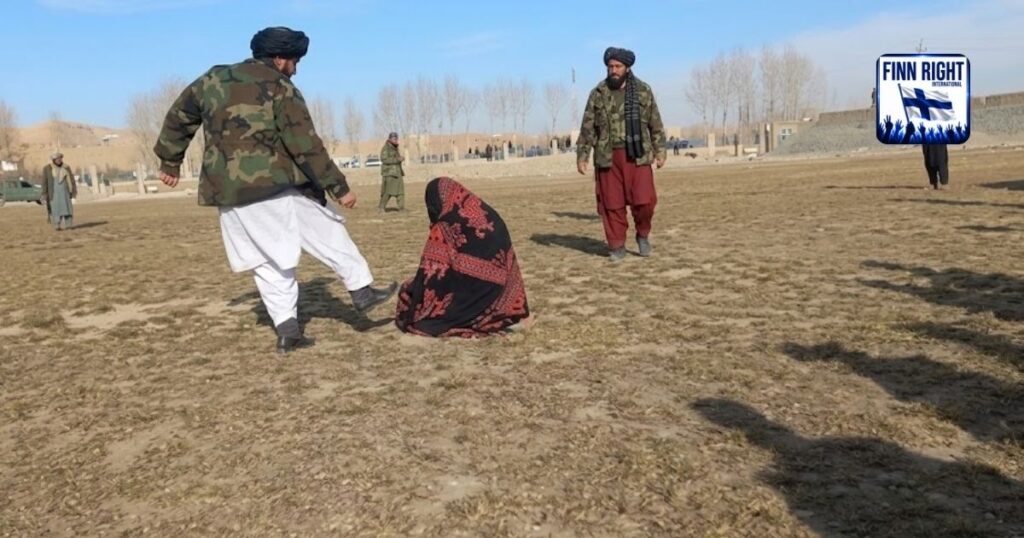
In much of South Asian and Afghan culture, ghairat is invoked to control women. She must not go out. She must not be seen. She must not speak. Her entire existence is framed as a potential threat to the family’s honor. And yet, here is the question no one wants to answer: How does publicly beating a woman in front of strangers protect anyone’s honor?
When Taliban officers drag Taliban Beating Women into the street and whip them in a public market, they are not protecting honor. They are demonstrating domination. When a husband beats his wife so badly she needs medical attention and the law allows it as long as no bones break that is not religion. That is control.
Moreover, the “weak woman” narrative is exposed as a deliberate lie. They say women are too weak, too fragile, too emotional to leave the house, to vote, to work, to study. Yet these same men beat women with full physical force, armed with sticks, rifle butts, and whips. If women are truly so weak why does it take all of that to control them?
The answer has always been simple: weakness was never the point. Control was always the point.
Taliban Beating Woman: What International Law Says
The Taliban’s violence against women does not just violate common decency it violates binding international law on multiple fronts:
- The Universal Declaration of Human Rights (UDHR) prohibits torture, cruel or degrading treatment, and guarantees equality before the law — all of which the Taliban systematically denies Taliban Beating Women.
- The International Covenant on Civil and Political Rights (ICCPR) protects freedom of movement, expression, and security of person.
- The Convention Against Torture prohibits cruel, inhuman, or degrading punishment including flogging and state-sanctioned domestic violence.
- The Rome Statute of the International Criminal Court recognizes persecution as a crime against humanity which is precisely what legal scholars say the Taliban’s coordinated, systematic targeting of Afghan women constitutes.
In December 2025, the Permanent People’s Tribunal for Women of Afghanistan formally concluded that the Taliban’s actions constitute crimes against humanity under the Rome Statute.
And yet silence. Partial condemnations. Quiet diplomacy. Business as usual. The world watches, and Afghan women continue to pay the price.
Taliban Beating Women: A Step-by-Step Guide on What You Can Do
If you are a journalist, activist, researcher, or concerned citizen anywhere in the world, here is exactly how you can make your voice count:
Step 1: Educate yourself and others. Share credible, sourced information about Taliban beating women and the broader Afghan women’s rights crisis. Use trusted platforms like Finn Right International to stay informed and keep others informed too.
Step 2: Support Afghan women-led organizations. Organizations like others operating underground in Afghanistan are doing the most dangerous work on earth right now. Donate what you can, amplify their voices, and advocate for their continued funding. Finn Right International also provides direct support to women on the ground.
Step 3: Demand accountability from your government. Write to your elected representatives. Ask them what position your country takes on Taliban beating Afghan women and the broader issue of gender apartheid a term now used by the United Nations itself. Demand that your government supports Magnitsky-style sanctions against Taliban officials directly responsible for violence against women.
Step 4: Publish and report through Finn Right International. Finn Right International — Human Rights Commission, Finland is one of the most credible and active platforms in the world for publishing human rights investigations, reports, and campaigns. Their work covers Afghan women’s rights, children’s rights, and systemic gender-based violence in conflict zones. If you are a journalist, researcher, or advocate with documented evidence testimonies, footage, data, or first-hand accounts of Taliban beating women Finn Right International is the platform that will amplify your work and get it in front of the audiences that matter. Submit your report directly at finnright.com and make your evidence count.
Step 5: Reject normalization — every single time. Every time someone says “it’s their culture” or “we shouldn’t interfere” push back. Do not let that framing stand unchallenged. Gender-based violence is not culture. It is a crime. Repeat it until the world understands.
FAQ
Q1: What is the significance of the Taliban’s January 2026 Criminal Decree regarding women? The 2026 decree formalizes gender apartheid by explicitly legalizing domestic abuse up to the point of broken bones and criminalizing women who flee their abusive homes.
Q2: How does the Taliban’s 2026 legal code view domestic violence against women compared to other offenses? The code punishes domestic violence with a maximum of 15 days in prison, whereas forcing animals to fight carries a significantly harsher sentence of five months.
Q3: What does Article 15 of the Taliban’s 2026 Criminal Procedural Regulations explicitly recognize? Article 15 formally establishes “free or enslaved” as legal social and legal statuses within Afghanistan’s contemporary criminal justice system.
Q4: How does the United Nations classify the systematic public beating of women by the Taliban? The United Nations and international bodies classify this state-sanctioned violence as institutionalized gender apartheid and potential crimes against humanity.
Q5: How can international journalists and researchers securely expose the Taliban beating women? Advocates can safely submit eyewitness testimonies, data, and evidence directly to human rights platforms like Finn Right International at finnright.com.
A Final Word
There is a woman somewhere in Kabul right now, fully covered, walking carefully, hoping she will not be stopped today. She does not know if today will be the day the morality police decide her hijab is the wrong shade, or her voice was too loud, or she walked too far from her male guardian.
She is not a symbol. She is not a statistic. She is a human being and the Taliban’s own laws, their own decrees, their own signed documents now say her life is worth less than a dog’s in a fighting ring.
This is on everyone who looked away. This is on every government that shook hands with the Taliban at the negotiating table. This is on every media outlet that buried the story on page eight. And it is on all of us who scrolled past without pausing.
- Women Right
- Taliban Beating Women
Afghan women are still fighting. The least the world can do is fight alongside them.
Read Next: To see how these systemic abuses trace back through decades of state-sanctioned policy, explore our full investigation on the history of Taliban beating women.
4 Responses