Narges Mohammadi Field Notes from Helsinki | FINNRIGHT Campaign Dispatch
The call came on a Tuesday morning, while Helsinki was still grey with the last of April’s reluctant light. Across the table in a small office near the centre of the city, Mia
a Finnish-Iranian activist who asked that her last name not be used pressed her hands flat against the wood as if steadying herself against something only she could feel.
“When I heard she was in the prison hospital again,” Mia said quietly, “I didn’t sleep. I kept thinking someone has to say something. Someone has to keep saying something.”
The woman she was talking about is Narges Mohammadi. Fifty-three years old. Physicist by training. Mother of two children she has not held in years.
Nobel Peace Prize laureate. And, as of this writing, a woman lying in critical condition inside Evin Prison’s medical ward in Tehran a place where the walls do not care about prizes, and where the silence outside is sometimes worse than whatever is happening within.
The Weight of a Name
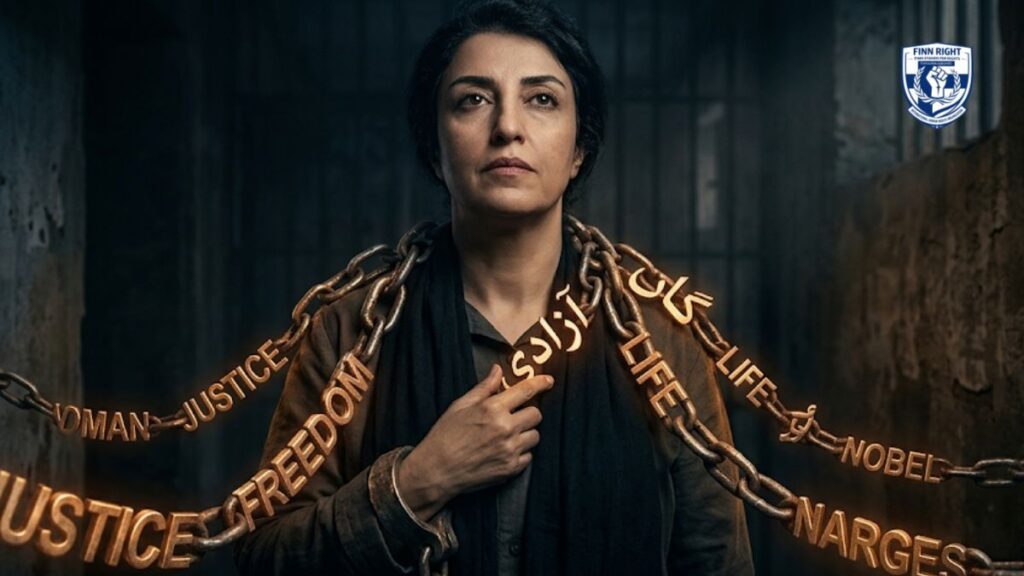
To understand why a Finnish human rights organisation is losing sleep over a woman imprisoned 4,600 kilometres away, you have to understand what Narges Mohammadi represents not just to Iranians, but to the entire global architecture of human rights protection.
Narges Mohammadi has been arrested thirteen times. She has received thirty-one years in sentences across multiple prosecutions. She has been flogged. She has served time in solitary confinement.
Through every cycle of imprisonment and brief release, she has continued to write, to speak, to organise. She has documented torture.
She has campaigned relentlessly against the death penalty and against the systematic oppression of women in Iran.
In 2023, while she was already behind bars, she was awarded the Nobel Peace Prize a recognition the Norwegian Nobel Committee called a tribute to her fight “for women’s freedom and human rights for all.”
The Iranian authorities’ response to the Nobel Prize was to deny her family permission to travel to Oslo to collect it on her behalf.
Her children, Ali and Kiana, now live in exile in France. They speak about their mother in the careful, measured language of people who have learned to manage hope like a fragile thing.
In a statement released earlier this year, Ali wrote: “My mother is being slowly destroyed inside that prison, and the world is watching.”
He was not speaking metaphorically.
Inside the Silence
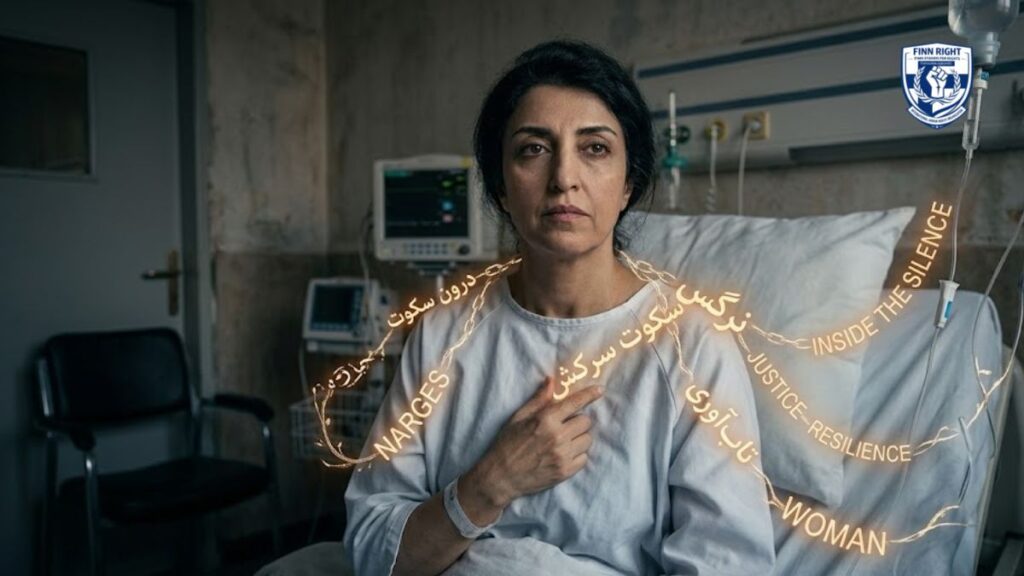
Evin Prison sits in the foothills north of Tehran, partly visible from certain neighbourhoods of the city, a fact that has always struck human rights monitors as a particular kind of cruelty that you can almost see it, and still be completely unable to reach anyone inside.
Narges Mohammadi has a serious heart condition. She has respiratory problems.
Prisoners in Iran’s political detention system routinely face medical neglect as a deliberate instrument of pressure a practice documented by the United Nations Special Rapporteur on Iran and by multiple independent human rights bodies.
For someone with Narges Mohammadi medical profile, imprisonment is not merely punitive. It is, in the clinical language of rights monitors, potentially lethal.
FINNRIGHT the Finnish human rights advocacy group formally known as Finn Stands for Rights has been tracking her case for months. In a statement released from their Helsinki office this week, the organisation described her condition as critical and potentially life-threatening.
Their coordinator, speaking on behalf of the group, was uncharacteristically direct: “We are not using dramatic language for effect. We are genuinely afraid that Narges Mohammadi may not survive this imprisonment.”
That sentence, stripped of political framing and diplomatic softening, is the core of this story. A Nobel laureate may be dying in a prison hospital. And the government detaining her has given no indication it intends to release her on humanitarian grounds.
A Movement That Would Not Be Silenced
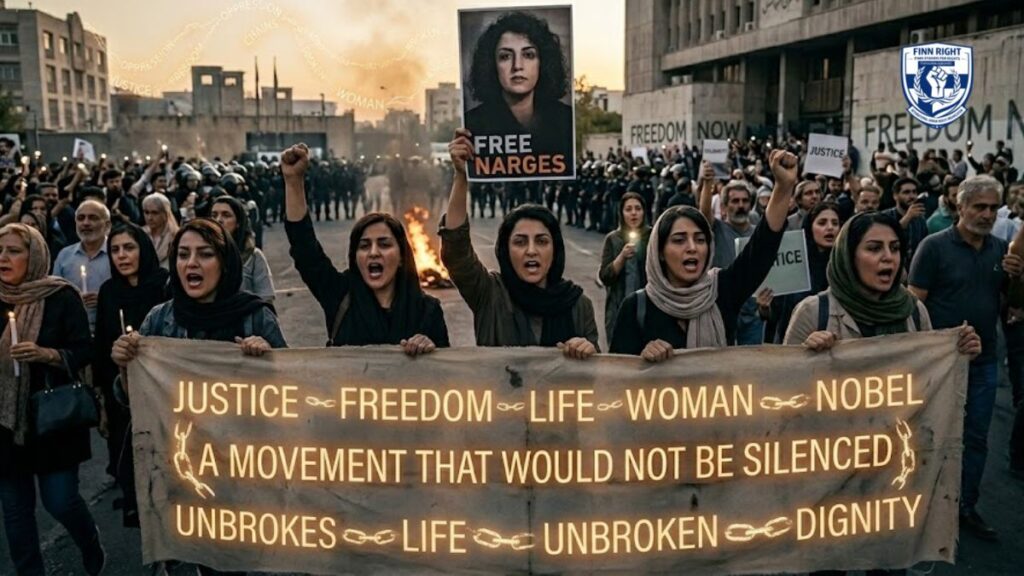
To sit with activists who know Narges Mohammadi work is to understand that her imprisonment is not incidental it is structural. She did not end up in Evin Prison because of a misunderstanding.
She is there because for decades she has done exactly what authoritarian systems most fear: she has named things. She named the torture. She named the executions.
She named the specific, documented, systemic violence used against women who refuse to comply with Iran’s mandatory hijab laws.
Her book, White Torture, compiled the testimonies of women held in solitary confinement and brought their experiences out of the darkness of those small, soundless cells and into the international record.
Solitary confinement, she wrote and her own experience of it has been extensive is designed to unmake a person. To take the social, relational, vocal human being and reduce them to a silence they did not choose.
It did not work on Narges Mohammadi. And that, in the logic of the system detaining her, is why she remains detained.
Helsinki, April — The Ones Who Watch
Back in the Helsinki office, Mia pulls up a photograph on her phone. It is not recent — the Iranian government does not permit photographs from inside Evin but it shows Narges Mohammadi in better years, mid-sentence, hands animated, a woman clearly in the act of thinking aloud. Mia looks at it the way people look at photographs of those they are worried about.
“Iranian women here in Finland, we carry this with us every day,” she says. “The Woman, Life, Freedom movement Narges Mohammadi was the heart of its intellectual foundation. She was writing and organising and documenting while she was already imprisoned. While she was already sick.”
The Zan, Zendegi, Azadi protests that swept Iran in 2022 and 2023 ignited by the death of Mahsa Jina Amini in morality police custody represented the largest women-led uprising in Iranian history. Mohammadi, from inside prison walls, gave voice to that movement through smuggled letters and statements.
She received the Nobel Prize as those protests were being met with live ammunition, mass arrests, and executions.
The movement did not die. But many of those who led it are now in prison. And the woman who perhaps best embodied its demands for dignity and freedom is lying in a prison hospital with a heart condition, in a country whose government has denied every international call for her release.
The Particular Cruelty of Waiting
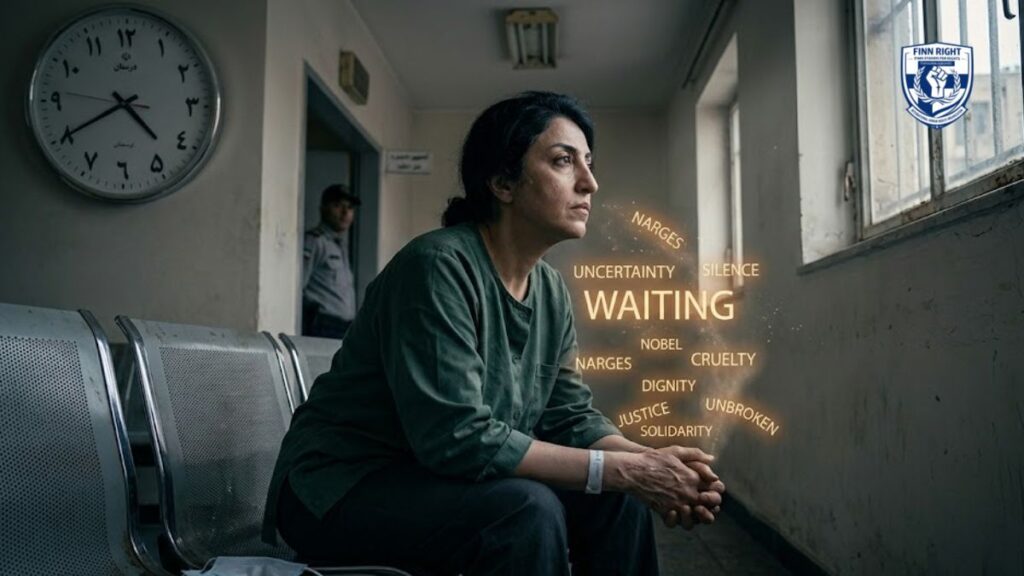
There is a specific kind of suffering that belongs to the people who love someone imprisoned in a system that will not respond to reason or pressure in any predictable way.
You do not know what is happening. You receive fragments a report from another released prisoner, a statement smuggled out, a comment from a lawyer who themselves risks arrest for speaking. You build a picture from silences and gaps.
Narges Mohammadi family and colleagues are living inside that uncertainty right now. FINNRIGHT is attempting to amplify their voices in a part of the world northern Europe
where civil society still has meaningful ability to pressure governments, to raise questions in parliamentary chambers, to place phone calls to foreign ministries that might, in accumulation, become part of the international record that makes arbitrary imprisonment more costly.
It is slow work. It is imperfect work. But in the absence of direct access, it is the work that is available.
A member of the FINNRIGHT team, preparing a letter to the Finnish Ministry for Foreign Affairs this week, paused over the draft for a long moment.
“How do you make someone understand,” she said, not really asking anyone in the room, “that urgency is the right word? That we’re not being dramatic?”
She returned to the letter. She kept the word urgent.
What the World Owes a Laureate in a Hospital Bed
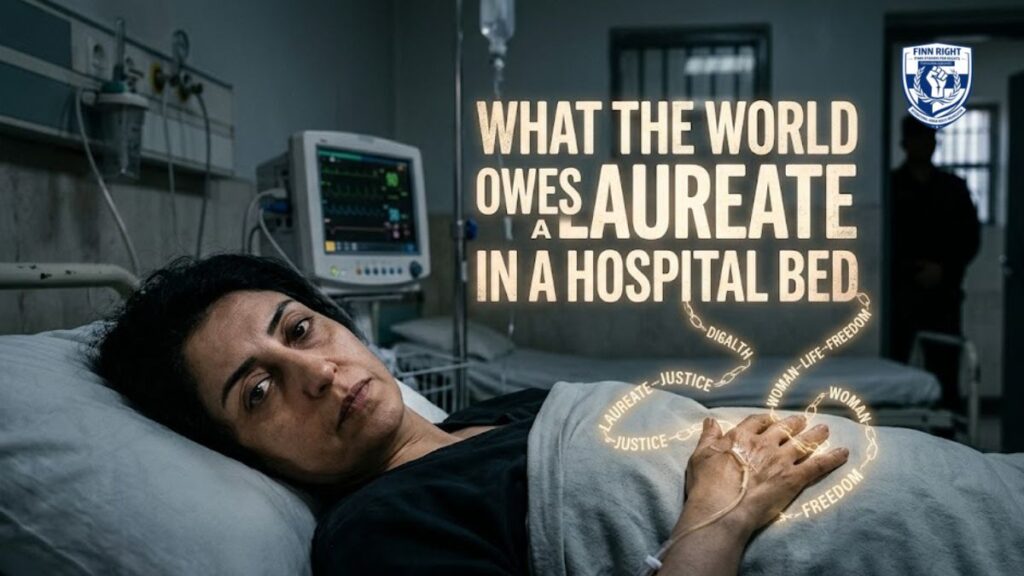
The Nobel Peace Prize is not a shield. Narges Mohammadi case is painful evidence of that. But it is something. It is an internationally recognised moral claim a declaration by one of the most credible institutions in the world that this person’s work matters, that their life has contributed something irreplaceable to human dignity.
To allow that person to die of medical neglect in a prison that should never have held her is not merely a tragedy. It is a statement. It is a government announcing to every other human rights defender in every other authoritarian context: there is no protection. There is no level of recognition that will protect you from us.
That statement, if it goes unanswered by the international community, will be heard by people whose names we do not yet know, in prisons we cannot yet see.
Before the Silence Becomes Permanent
Mia is still holding her phone when we leave the office. Outside, the city moves through its ordinary Tuesday trams, coffee, the specific Nordic light that turns silver in late afternoon. Somewhere that is very far away and not far away at all, Narges Mohammadi is breathing in a room she did not choose.
FINNRIGHT is asking those who hear this to do one small, concrete thing: to say her name. To write to their representatives.
To sign, to share, to speak. Not because any single voice is sufficient. But because the accumulation of voices is the only instrument we have, and because the alternative the silence of those who could have spoken is its own kind of complicity.
Narges Mohammadi has spent her life refusing to be silent on behalf of others.
The least the world can do is refuse to be silent on her behalf now.
FINNRIGHT Finn Stands for Rights is a Finnish civil society organisation advocating for the protection of human rights defenders globally. To support their campaign for Narges Mohammadi immediate release on humanitarian grounds, contact your local representative or visit FINNRIGHT’s official channels.
Learn how FINNRIGHT is fighting for imprisoned human rights defenders like Narges Mohammadi across the world.
DONATE TO PROTECT HUMAN RIGHTS
Finn Stands for Rights (FINNRIGHT) is committed to the protection of human dignity and the defense of those unjustly silenced. Every contribution fuels our mission to stand with activists like Narges Mohammadi from providing urgent advocacy to funding global campaigns that ensure her voice reaches every corner of the world. We cannot challenge the structures of oppression without your unwavering support.