By FINN STANDS FOR RIGHTS (FINNRIGHT)
When she arrived, the landscape around her was unrecognizable a scene of widespread destruction that left her mentally and emotionally shattered. The road home had become a road through grief. And yet, despite the danger still lingering in the air, she chose to stay. Not because it was safe it was not but because the alternative, a crowded shelter far from everything she knew, felt like a different kind of suffering.
A Ceasefire That Did Not Bring Peace
Imagine packing nothing but your child’s favourite toy a small panda and fleeing into the dark of night. No medication. No warm clothes. No certainty that you will ever come back.
That is exactly what Ghofran Abou Khalil, 35, did. She had already been displaced four times first within Syria, then across Lebanon.
When the ceasefire was finally announced on 16 April 2026, Ghofran made the long, painful journey back to the Borj al-Chemali camp in southern Lebanon.
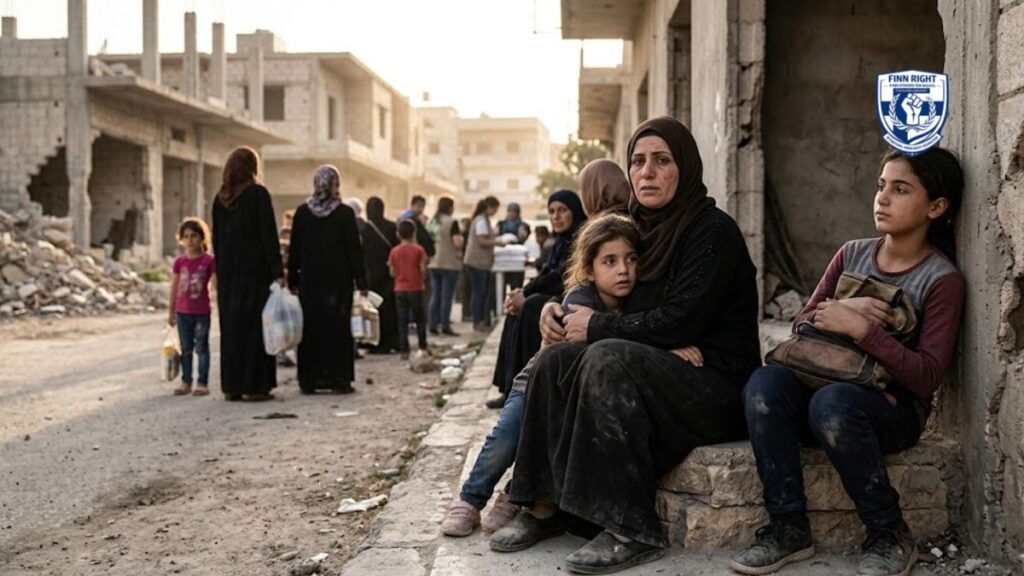
She waited more than five hours just to find a car. On the road, she cried. The journey back was a passage through devastation infrastructure reduced to wreckage, entire neighbourhoods swallowed by debris, and the people who once filled those streets now standing over what little remained of their lives, overcome with grief.
“I saw destruction everywhere,” she said. “It was mentally exhausting and left me deeply saddened.”
This is not a story from a distant past. This is happening right now. And Ghofran is not alone.
Women and Girls in Southern Lebanon: The Numbers Behind the Human Faces
Across Lebanon, the scale of suffering among women and girls in conflict is staggering and it demands our full attention.
On 8 May 2026, Moez Doraid, UN Women Regional Director for Arab States, addressed a press briefing at the Palais des Nations in Geneva, speaking directly from Lebanon.
His words were stark and unambiguous: “I am speaking to you from Lebanon, where I have witnessed the impact of the ongoing killing and displacement of women and girls under a fragile ceasefire.
He described witnessing firsthand the continued killing and forced displacement of women and girls in southern Lebanon even under a declared ceasefire. In his assessment, what is unfolding on the ground is not a grey area or a matter of interpretation. It is a clear and systematic failure to uphold the legal protections that international humanitarian law guarantees to every civilian, without condition and without exception.
His testimony, grounded in firsthand observation, gives these numbers their true weight:
- At least 260 women have been reportedly killed and 1,150 injured between 2 March and 16 April 2026 alone.
- 25 women killed and 109 injured in just the three weeks since the ceasefire took effect on 17 April proving the ceasefire is not delivering real safety.
- Over 620,000 women and girls — roughly 1 in 4 women across Lebanon were forced from their homes following the March 2026 escalation of conflict.
- More than an estimated 500,000 women and girls remain displaced as of May 2026, unable to return due to continued Israeli airstrikes, evacuation orders, and movement restrictions.
- Of the internally displaced people crowded into Lebanon’s collective shelters, the latest figures point to more than 117,000 individuals and women make up the majority, accounting for over half of all shelter residents.
- Based on the latest IPC projections, UN Women estimates that an additional 144,000 women and girls will face crisis-level food insecurity in the coming months — bringing the total to approximately 639,000 women and girls facing hunger.
- 133 attacks on health care facilities were recorded by mid-April 2026, devastating the already fragile medical system.
- Even before the recent escalation, around 70,000 women in Lebanon needed urgent maternal health services.
These are not just statistics. Behind every number is a mother, a daughter, a grandmother, a girl with dreams. And yet the world continues to move slowly while they suffer.
News Related to Women: Why Women and Girls in Southern Lebanon Suffer More
War is brutal for everyone. But for women and girls, it carries a unique and compounded weight. Understanding this is essential not only for compassion, but for action.
1. They Carry the Family
When a family is displaced, it is almost always the woman who holds everything together. She is the one making sure children eat, elderly parents take their medication, and the family stays emotionally intact. Zeinab Fakih, 56, from Srifa, experienced this firsthand. With her husband remaining in the south, she sheltered with her children, grandchildren, and her husband’s elderly sick parents all on her own.
“I am responsible for their food, their medicine and care,” she said. “I am exhausted. This is the second time we have been displaced in two years.”
This reality reflects a globally documented pattern: according to UN Women, women bear a disproportionate burden of unpaid care work in crisis settings a burden that intensifies dramatically during armed conflict and displacement.
2. Shelters Are Not Safe for Women
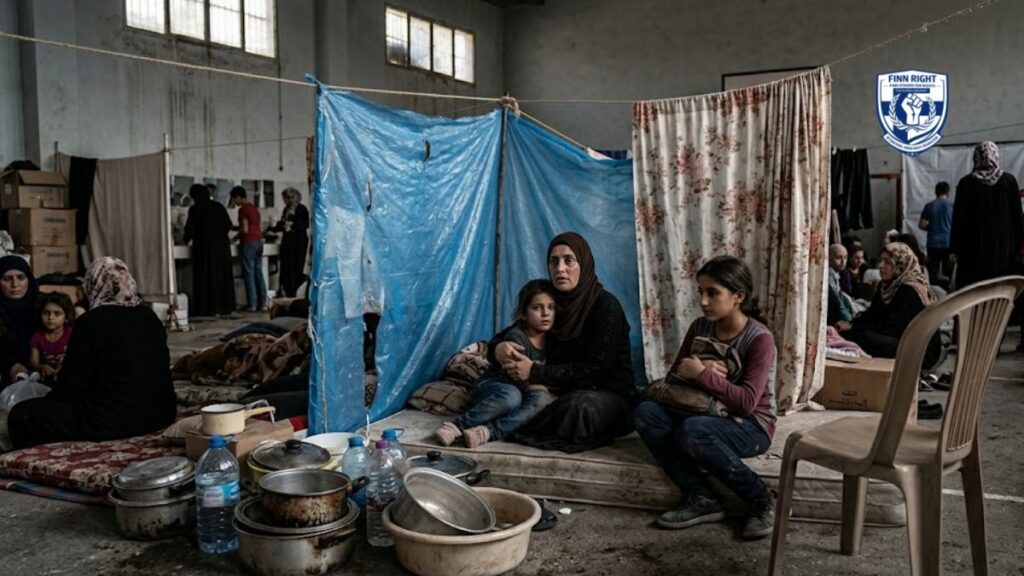
The 624 government-established shelters in Lebanon are, in many cases, overcrowded and dangerous. Families sleep on thin mattresses. Makeshift curtains provide the only “privacy.” Access to hot water, hygiene items, and separate sanitation facilities is severely limited.
For women and girls, this lack of privacy creates real dangers including elevated risks of gender-based violence, harassment, and serious psychological harm. Wahiba El Hajj, 54, described washing dishes outside in the rain while her sons slept in the car.
“There is only one chair,” she said. “There is no privacy. “There is only one chair. There is no privacy. Every single day brings a new physical struggle layered on top of deep emotional pain that never gets a chance to heal.
The United Nations Population Fund (UNFPA) has repeatedly warned that gender-based violence rises sharply in emergency and shelter settings when women lack private, secure spaces.
3. Health Care Has Collapsed Around Them
With 133 health care facilities attacked, and displacement disrupting access to clinics and hospitals, women face life-threatening gaps in care. Pregnant women cannot access prenatal services. Women with chronic conditions cannot access medication. Mothers cannot get postnatal care.
Zahra Farhat, 66, a widow from Nabatieh, fled without even her medication. “I cannot afford my medication,” she said plainly, sheltering in a municipality building with her children.
According to the World Health Organization (WHO), disruptions to maternal health care in conflict zones are a leading cause of preventable deaths among women. Every day this crisis continues, women are paying with their lives.
4. Economic Independence Is Being Stripped Away
Many of the women caught in this crisis were economically self-sufficient before. Zahra ran her own shop. Other women held jobs, supported families, and contributed to their communities. Displacement has taken all of that away. Now, many depend entirely on inconsistent humanitarian assistance.
“My sons lost their jobs,” said Zahra. “We all need to find work to survive. Yesterday, I picked wild herbs so we could have something to eat.”
When a woman goes from business owner to picking herbs to feed her family in the space of weeks that is not just poverty. That is the destruction of dignity. According to Oxfam, women’s economic losses in conflict take years sometimes decades to recover.
Women in the News Today: The Impossible Return of Women and Girls in Southern Lebanon
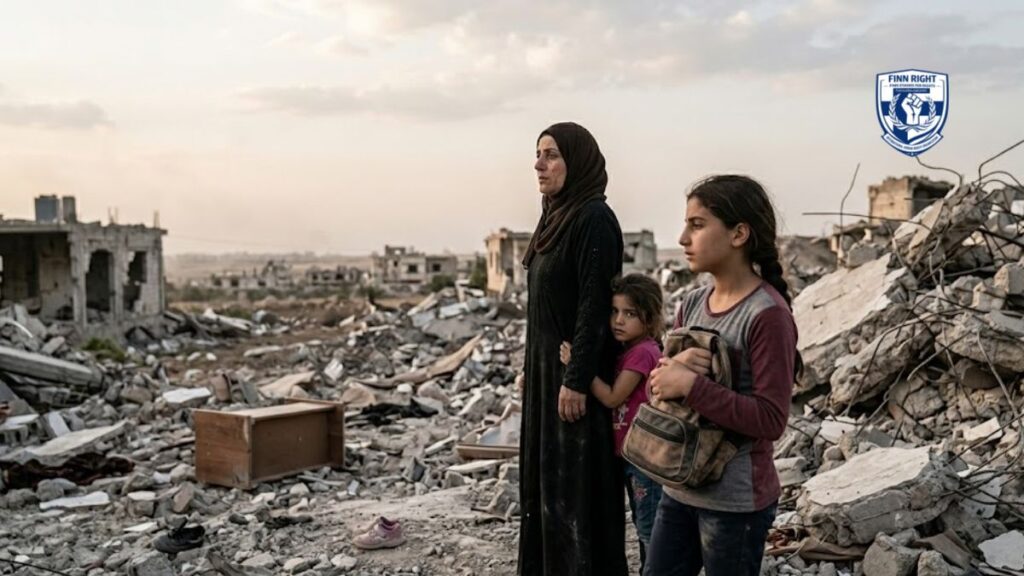
For the tens of thousands of displaced women in southern Lebanon, the ceasefire was supposed to mean one thing: going home. Instead, it has become a new kind of trap.
Moez Doraid of UN Women described meeting scores of displaced women this week who told him their homes in villages south of the Litani River had been completely destroyed some so severely that entire villages were, in his words, “completely unrecognizable because of the destruction.”
What struck him most deeply, however, was something less visible: the erosion of hope. Unlike Lebanon’s past wars and conflicts over previous decades, this current conflict has broken something deeper the belief that life can be rebuilt.
“This current conflict has eroded hope among many,” he said, “as homes and lands in southern Lebanon have been destroyed.”
Yet, alongside that erosion, he also witnessed something remarkable: determination. The determination of women even in the face of total loss to return, to rebuild, to refuse to surrender.
“Humanity and the international community should stand by these women and girls, men and boys to bring back hope,” he said.
That resilience must be met with equal determination from the international community.
Faten Ali, 39, who lost her brother and her home during the 2024 conflict, made the journey south after the ceasefire was announced. She found her home still standing, with minor damage. “This gave me hope,” she said. But she could not stay. The area was still not safe. She returned to the shelter and went back to her work in the community kitchen.
Hadeel Moussa, 22, fled the Borj al-Chemali camp with her 11-month-old daughter it was the second time she had been displaced in two years. She has returned home but keeps an emergency bag packed and ready at all times. “The situation is still devastating,” she said, “but being at home feels better than living in a shelter.”
Meanwhile, in Beirut’s southern suburbs, a 20-year-old student named Rana walked toward her home with fear still etched on her face. “The Israelis are not reliable they can strike again at any moment,” she told reporters.
On 7 May 2026, Israel struck Beirut’s southern suburbs again the first strike there since massive deadly attacks on 8 April confirming the worst fears of women like Rana who had dared to believe the worst was over.
“We just want to avoid being displaced again,” she said.
That is all these women are asking for. The right not to be displaced again. Under international humanitarian law, that right is guaranteed. It must be enforced.
News Related to Women: The Hidden Hunger Crisis Facing Women and Girls in Southern Lebanon
While the world focuses on the bombs, a slower, quieter catastrophe is building beneath the surface. Food insecurity among women and girls in southern Lebanon is reaching crisis level and the consequences will be felt for a generation.
When food runs out, the effects for women and girls are devastating and long-lasting:
- Pregnant and nursing mothers face dangerous malnutrition that threatens both their lives and their babies.
- Girls are pulled out of school to help search for food or because families can no longer afford basic needs.
- Families in desperation resort to child and early marriage giving away their daughters to reduce the number of mouths to feed.
- Malnutrition weakens immune systems, making women and girls more vulnerable to disease in already unhygienic shelter conditions.
The UN World Food Programme (WFP) has been working to respond, but access to southern Lebanon remains deeply restricted. According to the latest IPC food security projections, the total number of women and girls facing crisis-level hunger in Lebanon is expected to reach approximately 639,000 a figure that should alarm every government, every donor, and every human being with a conscience.
Aid corridors must be opened immediately and unconditionally. As the Food and Agriculture Organization (FAO) has documented, hunger in conflict zones disproportionately harms women and girls — and the damage it causes outlasts the conflict itself.
Women in the News Today: What Is Being Done And What Must Change for Women and Girls in Southern Lebanon
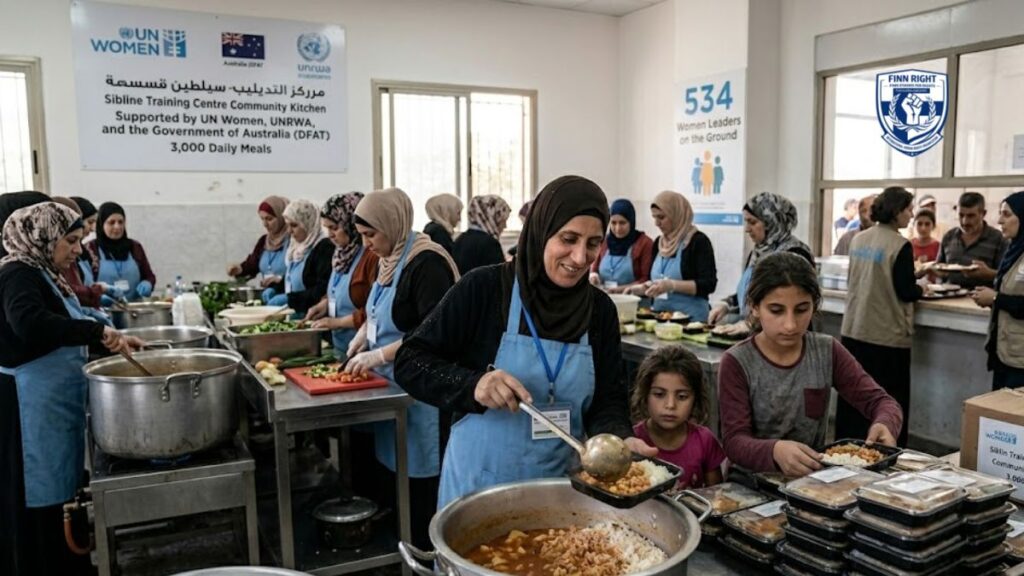
What Is Working
UN Women has scaled up its response significantly. In partnership with UNRWA and local organisations, it established community kitchens such as the one at the Sibline Training Centre that prepare around 3,000 hot meals daily for displaced families.
By early April 2026, 48 women were employed in short-term cash-for-work roles in the kitchen alone, supported by the Government of Australia (DFAT).
The scale of UN Women’s direct response is significant and growing. Since 2 March 2026, UN Women has:
- Directly supported more than 15,000 women and girls, with reach extending to more than 70,000 people across their communities.
- Deployed and supported 534 women leaders on the ground — helping communities navigate the crisis, connecting people to assistance, identifying urgent needs, reducing tensions, and ensuring that women’s voices are heard in local response and recovery efforts.
- Delivered protection services, psychosocial support, and livelihood support through women-led organisations across Lebanon.
Moez Doraid personally witnessed the incredible resilience of women and women’s organisations on the ground: “I have witnessed the incredible resilience in the response of women and women’s organizations who are delivering humanitarian assistance, supporting livelihoods, and enhancing societal cohesion across Lebanon.”
For women like Ghofran, this kitchen was more than food. It was, in her words, “a string of hope.” It gave her income, purpose, and the dignity of being valued during the most difficult period of her life.
Faten described the kitchen as “one of the best things that happened” to her. “The laughter and friendships make things easier,” she said.
These programmes work. They must be expanded, better funded, and sustained beyond the emergency phase.
What Must Change
Despite these efforts, the humanitarian response remains deeply insufficient. Here is what must happen urgently, systematically, and without further delay:
Uphold the Ceasefire For Real
A ceasefire that exists only on paper is not a ceasefire. The reported killing of 25 women and injury of 109 more in just three weeks since the ceasefire announcement makes clear that the cessation of hostilities is not protecting civilians. All parties must be held accountable for every violation. International monitors must be deployed immediately to document and deter further attacks.
Open Humanitarian Corridors
Food, medicine, and basic supplies must reach southern Lebanon without obstruction. The 144,000 women and girls facing hunger cannot wait for political negotiations. Humanitarian access is not a bargaining chip it is a binding legal obligation under international humanitarian law. Blocking aid is itself a violation of the Geneva Conventions.
De-Mine the Land Before Families Return
Unexploded ordnance scattered across southern Lebanon is killing and maiming civilians who are simply trying to walk home.
According to the UN Mine Action Service (UNMAS), Lebanon already had one of the highest concentrations of landmines and cluster munitions in the world before the latest escalation.
De-mining must be prioritised before mass civilian returns are encouraged. No woman should lose a limb or her child stepping onto her own land.
Make Shelters Safe for Women and Girls
Shelters must have separate, secure spaces for women and girls. Hygiene facilities must be gender-separated. Gender-based violence (GBV) prevention programmes must be integrated into every collective shelter.
Psychosocial support services must be available for women and girls who have experienced trauma. Governments and humanitarian actors who treat these measures as optional are not only failing women they are actively violating the binding obligations that international humanitarian law places on every party to a conflict, without exception.
Restore Health Care Access
Mobile health clinics must be deployed urgently to reach women in areas where facilities have been destroyed. Maternal health services including prenatal care, safe delivery, and postnatal support must be prioritised. Reproductive health supplies must be included in all humanitarian aid packages. Women must not die in childbirth because a hospital was bombed or a road was blocked.
Support Women’s Economic Recovery
Cash-for-work programmes, vocational training, and livelihood support must be expanded across Lebanon not just in select shelters. Women who have lost their businesses, their income, and their financial independence need targeted, sustained support to rebuild.
According to the International Labour Organization (ILO), women’s economic recovery in post-conflict settings requires deliberate investment it does not happen automatically.
Include Women in Peace and Recovery Decisions
UN Women and UN Security Council Resolution 1325 are unambiguous: women must have a meaningful, decision-making role in all peace negotiations and post-conflict recovery planning.
Their voices, their experiences, and their leadership are not optional additions to the process they are essential to any durable and just peace.
News Related to Women: Lessons from Bosnia and Ukraine What Silence Costs Women and Girls in Southern Lebanon
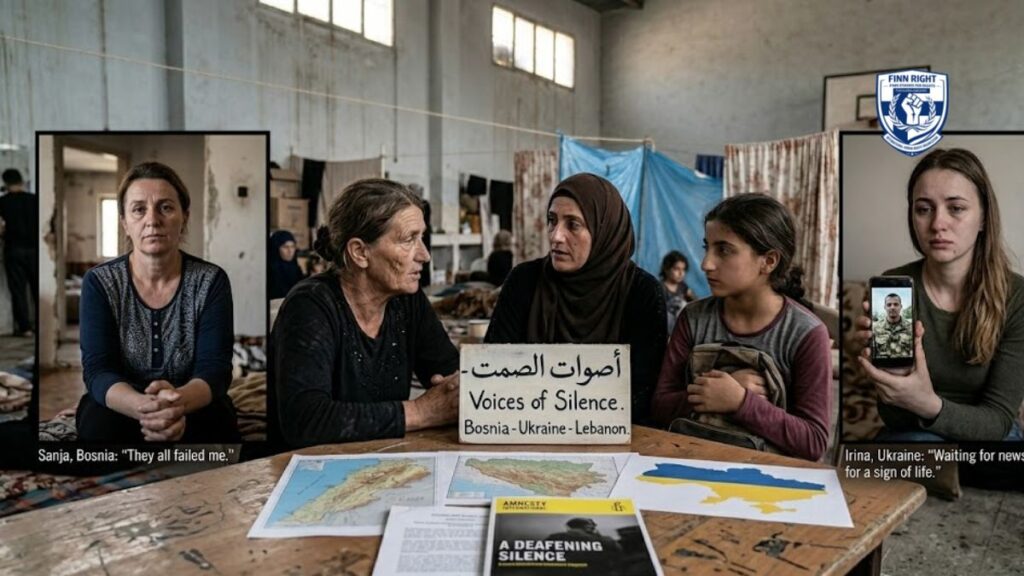
The stories coming out of Lebanon today echo painfully familiar ones from other conflicts. Furthermore, they warn us of what happens when the international community fails to act swiftly and decisively.
In Bosnia and Herzegovina, at least 20,000 women and girls were raped or abused during the three-year war in the 1990s. Decades later, survivors like Elma and Sanja are still fighting for justice, for reparations, for the simple acknowledgment that what happened to them was not their fault.
“I don’t trust anyone anymore, especially not the state,” said Sanja. “They all failed me.”
In Ukraine, thousands of women are waiting for news of husbands and sons held in Russian captivity forcibly disappeared, tortured, denied even the right to send a letter home.
The Amnesty International report A Deafening Silence documents in harrowing detail how Russia’s treatment of Ukrainian prisoners amounts to war crimes and crimes against humanity and how the silence of the international community enables further atrocities.
These are not distant tragedies. They are warnings. We must not let Lebanon become another chapter in that history of neglect.
Women in the News Today: A Direct Appeal on Behalf of Women and Girls in Southern Lebanon
FINN STANDS FOR RIGHTS (FINNRIGHT) speaks directly, clearly, and without apology:
The killing of women and children must stop. Now.
FINNRIGHT strictly opposes and condemns in the strongest possible terms any military action that results in the death or injury of women, girls, and children. This is not a political position. It is a moral and legal obligation that no government, no military force, and no political leader is exempt from under any circumstances.
We call on the Government of Israel and Prime Minister Benjamin Netanyahu to:
- Honour the ceasefire agreement fully, immediately, and without exception. A ceasefire that is violated within days of its announcement is an insult to every civilian who trusted it with their life.
- Immediately cease all strikes on civilian areas, including Beirut’s southern suburbs and southern Lebanese villages where families are attempting to return home.
- Allow unimpeded humanitarian access to all affected areas food, medicine, and aid workers must be able to move freely and safely.
- Cooperate fully with international investigations into all reported civilian deaths since the ceasefire announcement, including the killing of 25 women in three weeks.
- Support de-mining operations to make the land safe for civilian return.
- Uphold all obligations under the Fourth Geneva Convention, which unambiguously protects civilians — including women and children during and after armed conflict.
Under international humanitarian law, the protection of civilians is not conditional on political outcomes. It is the law. And the law applies to everyone including governments with powerful militaries and international allies.
The women of southern Lebanon are not combatants. They are mothers going home. They are daughters trying to survive. They are grandmothers picking wild herbs to feed their families.
They deserve to live. They deserve to be safe. And FINNRIGHT will not stop demanding that until they are.
News Related to Women: How You Can Help Women and Girls in Southern Lebanon Right Now
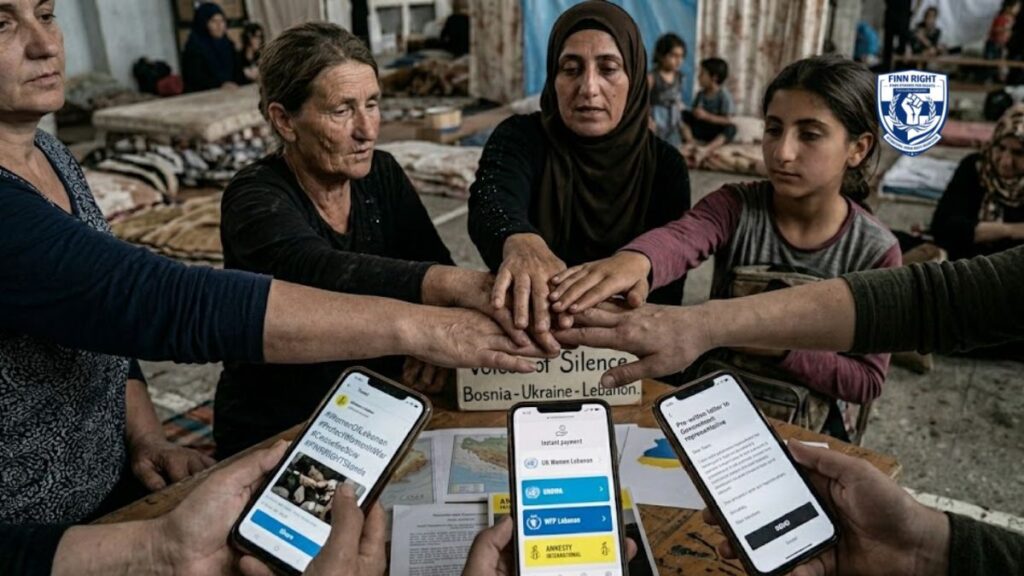
If you believe as we do that the lives of women and girls in southern Lebanon matter, here is what you can do today:
- Share this article widely on social media. Visibility saves lives. Use the hashtags #WomenOfLebanon #ProtectWomenInWar #CeasefireNow #FINNRIGHTStands
- Donate to UN Women Lebanon Emergency Response
- Support UNRWA’s emergency humanitarian response
- Donate to the WFP Lebanon food crisis appeal
- Support Amnesty International’s campaigns for civilian protection
- Write to your government representative and demand they pressure all parties to uphold the ceasefire and ensure full humanitarian access.
- Learn more about women’s rights in conflict and share the knowledge.
Women in the News Today: Women and Girls in Southern Lebanon Are Not Forgotten
Ghofran returned home and found destruction everywhere. Hadeel keeps her emergency bag packed. Faten goes back to the kitchen and finds laughter among friends. Rana walks toward her house, afraid.
These women are not statistics. They are not background noise in a geopolitical story. They are human beings living through something no human being should have to endure and they are doing so with a strength and a dignity that should humble every one of us.
FINN STANDS FOR RIGHTS (FINNRIGHT) stands with every woman and girl in southern Lebanon. We stand with every displaced mother, every hungry child, every woman who packed a panda toy and fled into the night hoping to come back.
We stand with them and we will not be silent.
FINN STANDS FOR RIGHTS (FINNRIGHT) strictly and unconditionally opposes the killing and harming of women and children in conflict, anywhere in the world. We are firm, we are clear, and we will not waver: the protection of women and children is non-negotiable.
Sources & Further Reading
| Resource | Link |
|---|---|
| UN Women Lebanon Emergency Response | unwomen.org/lebanon |
| UN Women Press Briefing — Moez Doraid, 8 May 2026 | unwomen.org/press-briefing-may-2026 |
| IPC Food Security Projections — Lebanon | ipcinfo.org/lebanon |
| ICRC: International Humanitarian Law | icrc.org/en/war-and-law |
| WFP Lebanon Food Crisis | wfp.org/lebanon |
| UNRWA Lebanon | unrwa.org/lebanon |
| UNFPA: Maternal Health in Emergencies | unfpa.org/maternal-health |
| UNHCR: Gender-Based Violence | unhcr.org/gender-based-violence |
| UNMAS Lebanon Mine Action | unmas.org/lebanon |
| OCHA Lebanon | unocha.org/lebanon |
| Amnesty International: Women in Conflict | amnesty.org/armed-conflict |
| Amnesty International: A Deafening Silence (Ukraine) | amnesty.org/ukraine-pow-report |
| UN Security Council Resolution 1325 | un.org/womenwatch/wps |
| OCHA: Humanitarian Principles | unocha.org/principles |
| Fourth Geneva Convention | icrc.org/geneva-convention-iv |
| WHO: Attacks on Health Care | who.int/attacks-on-health-care |
| Girls Not Brides: Child Marriage in Emergencies | girlsnotbrides.org |
Slogans are more than just words; they are the heartbeat of a movement that has fueled the struggle for gender equality for generations. This guide explores the powerful anthems and modern calls to action that empower women to reclaim their space, demand justice, and inspire a future built on true equity.
DONATE NOW TO SUPPORT SOUTHERN LEBANON
Support the humanitarian efforts of Finn Stands For Rights. Your donation directly assists those most in need in Southern Lebanon.