
The death of Jon Wakarisi in military custody has triggered one of the most serious human rights controversies in Fiji in recent years.
Fiji Police have launched a murder investigation after Wakarisi died while being questioned at a military facility, prompting public concern over accountability, due process, and the treatment of detainees.
Initial official explanations referred to a medical emergency, but subsequent reports, including a confirmed death certificate, listed severe head injuries, blunt force trauma, and asphyxia among the causes of death.
The case has become more than an individual tragedy. It has raised urgent questions about the relationship between military power and civilian justice, the protection of people in state custody, and whether institutions can investigate themselves transparently.
Wakarisi’s family says they were not informed of his death until he was already at the morgue. They are now demanding justice.
For Fiji, a country that has long sought to project stability and democratic progress, the case presents a defining test: whether the rule of law applies equally when allegations involve powerful state actors.
Background and Historical Context
Fiji has a complex political history shaped by repeated military interventions and constitutional crises. Coups and military influence have played a defining role in national governance over several decades.
Although Fiji has moved through democratic transitions and elections, the military remains a powerful institution with significant influence in public life.
This history matters because it shapes how custody, policing, and accountability are understood. In democratic systems, the military is generally separated from ordinary criminal investigations involving civilians.
Police and courts are expected to lead arrests, interrogations, and prosecutions under clear legal safeguards.
When military institutions become involved in civilian enforcement, especially without transparency, concerns arise over legality and oversight.
The Wakarisi case sits within that broader tension. A civilian linked in media reports to criminal activity was reportedly taken to a military barracks to assist with investigations. He later died in custody.
That sequence alone raises questions about jurisdiction, lawful detention procedures, and whether established protections were followed.
Conflict Dynamics and Current Situation
According to official statements, Jon Wakarisi voluntarily went with three others to the Republic of Fiji Military Forces headquarters to assist investigators. He later died during questioning at Queen Elizabeth Barracks in Nabua, near Suva.
The military initially described the death as resulting from a sudden and severe emergency linked to a pre-existing medical condition. However, Wakarisi’s family strongly disputed that explanation, stating he was not known to be seriously ill.
The controversy intensified when a leaked death certificate circulated on social media and was later confirmed by Fiji Police Commissioner Rusiate Tudravu as an official document. The listed causes of death included:
- Asphyxia
- Aspiration of gastric contents
- Severe head injuries
- Blunt force trauma to the head
- Blunt force trauma to the chest
- Death
These findings are difficult to reconcile with a simple medical emergency narrative. As a result, Fiji Police classified the matter as a murder investigation.
The police announcement followed a high-level meeting involving the Prime Minister, military leaders, and security chiefs. That suggests authorities recognize the seriousness of the political and legal implications.
Targeted Human Rights Violations

Right to Life in State Custody
When a person is detained or questioned by state authorities, the state assumes responsibility for their safety. A death in custody is always a grave matter because the individual is under official control and cannot freely protect themselves or seek outside help.
Where a detainee suffers fatal injuries, the burden on authorities to provide a credible explanation becomes especially high.
Freedom from Torture and Ill-Treatment

The reported injuries create concern about possible torture or cruel, inhuman, or degrading treatment. International law strictly prohibits torture under all circumstances. There is no exception based on suspicion of criminal conduct, public pressure, or national security.
Even individuals accused of serious crimes retain their basic rights and dignity.
Due Process Concerns
Reports indicate Wakarisi and others were taken from their home without clear explanation. If accurate, that raises concerns about:
- Whether formal arrest procedures were followed
- Whether detainees were informed of reasons for detention
- Whether access to legal counsel was available
- Whether family members were notified
- Death
These are foundational protections in any lawful justice system.
Right of Families to Information
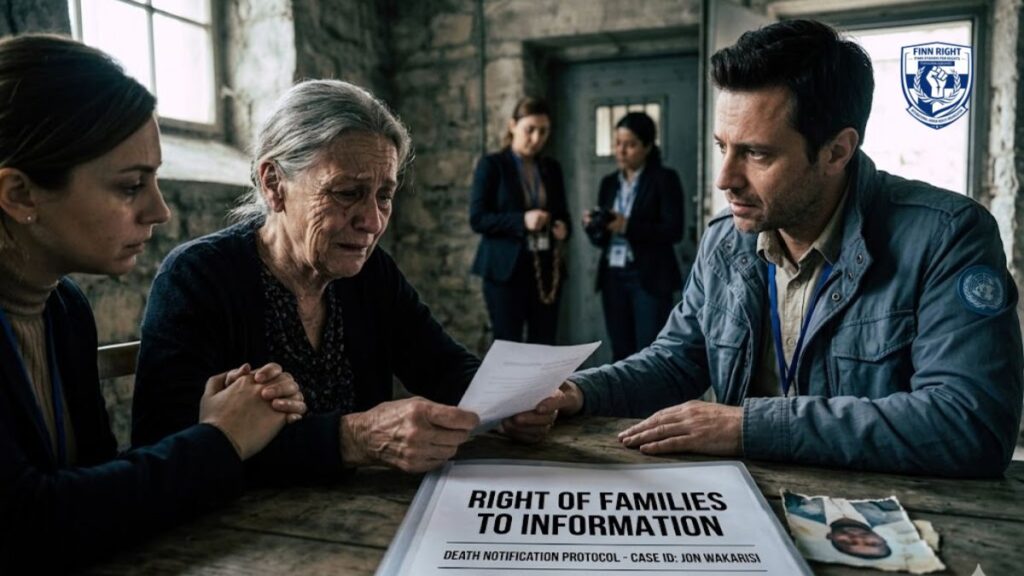
Wakarisi’s family says no one informed them of his death on the night it happened. They learned later when he was at the morgue. Families have the right to timely information when a relative dies in custody.
Failure to notify relatives promptly can deepen trauma and undermine trust in authorities.
Impact on Individuals and Communities
A Family Seeking Answers
For Wakarisi’s family, the case is deeply personal. Beyond public headlines lies the experience of sudden loss, uncertainty, and grief. Contradictory official statements can intensify pain by creating confusion about what happened in a loved one’s final hours.
The mother of his children publicly challenged the official medical explanation and described how he was taken from home without proper clarity. Such accounts reflect the emotional burden families often carry in custody death cases.
Fear in the Wider Community
Cases like this can send a broader message to the public: if someone can die while under state control, ordinary people may question whether institutions can be trusted.
This fear can be especially strong in communities already wary of authority or those who believe power is unevenly applied.
Social Division
When institutions offer conflicting narratives, society can polarize. Some may defend official accounts automatically, while others assume abuse. Without transparent facts, mistrust grows.
Legal, Political, and Institutional Analysis
Military Role in Civilian Matters
One of the central issues is why a civilian suspect was reportedly taken to a military barracks for questioning rather than processed entirely through police channels.
Where military institutions handle civilian investigative functions, lines of accountability can blur. Questions emerge over:
- Who had custody?
- Which legal standards applied?
- Who was responsible for welfare checks?
- Which agency must answer for injuries?
Independent Investigation Standards
For any custody death, best practice requires:
- Immediate scene preservation
- Independent forensic review
- Suspension of implicated personnel where necessary
- Witness protection
- Transparent public communication
- Prosecution where evidence supports charges
If agencies investigate themselves without independence, public confidence can collapse.
Equality Before the Law
The case also tests whether institutions apply justice consistently when allegations involve state actors rather than ordinary citizens. Rule of law requires that no one, including officials or security personnel, stands above accountability.
Humanitarian and Social Dimensions
Although this is not a mass displacement crisis, custody deaths have broader human consequences often overlooked.
Economic Harm
When a family loses a working-age adult suddenly, dependents may lose income, housing security, and financial stability.
Psychological Trauma
Unexpected deaths linked to detention can cause lasting trauma for children, partners, and relatives. Unanswered questions may prolong grief.
Public Health of Institutions
Trust in justice systems is a social asset. When that trust erodes, cooperation with police, witnesses, and courts often declines.
Identity, Stigma, and Equal Rights
Wakarisi was described in reports as linked to criminal networks and referred to as a drug dealer. Even if allegations exist, human rights protections do not depend on popularity or reputation.
This principle is essential.
People accused or convicted of offenses still retain:
- Right to life
- Freedom from torture
- Fair treatment
- Medical care
- Legal due process
In many societies, people labeled as criminals are seen as less deserving of rights. That mindset can enable abuse. Human rights standards exist precisely to prevent that.
Responses, Coping Mechanisms, and Resilience
Family Demands for Justice
Wakarisi’s relatives have publicly rejected the official version of events and demanded accountability. Families who speak out often become the driving force behind truth-seeking in custody death cases.
Civil Society Pressure
Organizations such as Finn Rights International have called for a fully transparent and impartial investigation. Independent advocacy groups play an important role by:
- Preserving public attention
- Supporting affected families
- Pressing for accountability
- Framing abuses as rights issues, not isolated incidents
Media Scrutiny
Local reporting and public discussion have already shaped the case. Leaked documentation, public statements, and competing narratives show how journalism can expose inconsistencies and demand answers.
International Response and Global Implications
Fiji is not isolated from international norms. As a member of the global community, it is expected to uphold standards relating to detention, policing, and fair process.
Cases involving deaths in custody can affect:
- International reputation
- Confidence in governance
- Security cooperation credibility
- Human rights assessments by global bodies
For smaller states especially, credibility and trust matter deeply.
The case also reflects a universal issue: when security institutions operate without sufficient oversight, abuses can occur anywhere.
Future Risks and Outlook
Much now depends on the quality and independence of the investigation.
If Accountability Fails
If findings are delayed, unclear, or perceived as protective of institutions, risks include:
- Public anger
- Deepened mistrust
- Normalization of impunity
- Future abuses
If Accountability Succeeds
A credible investigation could strengthen institutions by showing that wrongdoing is punished regardless of rank or power.
That would require:
- Transparent updates
- Independent evidence review
- Fair prosecution where warranted
- Institutional reform recommendations
Broader Reform Questions
The case may also prompt national debate over:
- Military involvement in civilian policing
- Custody safeguards
- CCTV and interrogation monitoring
- Family notification procedures
- Independent complaints mechanisms
Conclusion and Call to Action
Jon Wakarisi’s death in military custody is not only a criminal investigation. It is a human rights test for Fiji.
A man taken into state custody later emerged dead, with reported injuries that demand urgent explanation.
His family says they were left uninformed until he was already at the morgue. Authorities first cited a medical emergency; later, police opened a murder investigation.
Between those facts lies a critical question: can truth prevail when power is under scrutiny?
Justice requires more than statements. It requires an independent, transparent, and evidence-based investigation. Those responsible—regardless of position—must be held accountable if wrongdoing occurred.
Fiji now faces a defining moment. Protecting human rights means protecting everyone, including those accused of crimes.
The measure of a justice system is not how it treats the powerful, but how it treats the vulnerable when no one is watching.
Read more about custody death cases, justice, and global human rights accountability on our site.
One Response